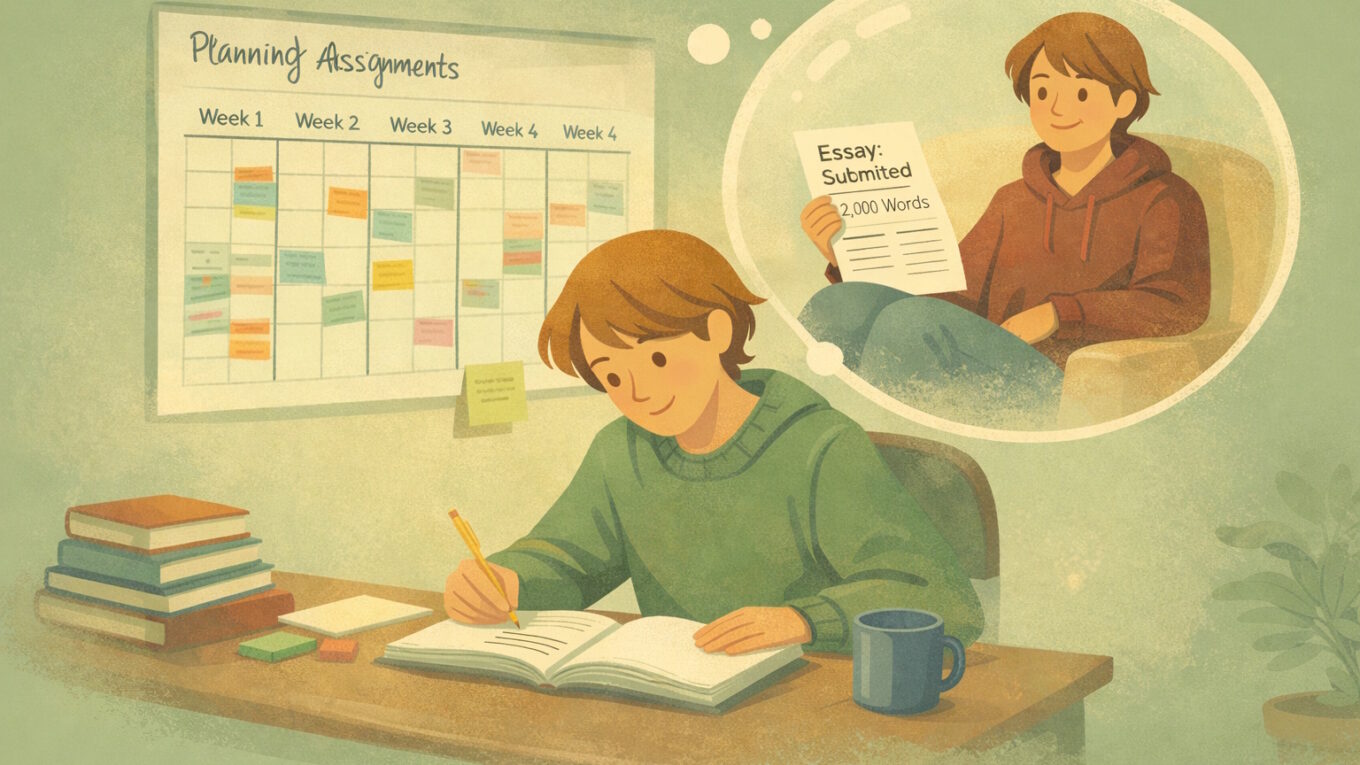
Planning Assignments When You’re Time Blind: A Step-by-Step Guide
If you’re time blind, assignments can feel like magic tricks.
One moment, your tutor sets a task that’s due in four weeks. That sounds like forever. Your brain can’t feel the difference between “four weeks from now” and “some vague point in the future”, so it slides off the task.
Then suddenly, the due date is next week. Or tomorrow. Or… earlier today.
If this happens to you a lot, you are not alone and you are not failing at being a student. Time blindness is a common part of many neurodivergent brains. It makes it genuinely hard to feel the passing of time, to estimate how long things will take, and to act now for something that matters later.
This guide will walk through planning one real assignment step by step, using “future me” language and working backwards from the deadline. Then you’ll get two templates you can adapt:
- a 4-week assignment plan, and
- a 1-week “oh no, I’ve left it late” plan.
The goal isn’t to turn you into a productivity robot. It’s to give your future self fewer horrible surprises.
Summary
- Time blindness means your brain struggles to feel the difference between “due in four weeks” and “due tomorrow”, so assignments tend to sneak up on you.
- Working backwards from the deadline turns that vague future into an external map your brain can actually see.
- Breaking one real assignment into small, visible steps is kinder and more effective than telling yourself to “just start earlier”.
- Using friendly “future me” language can make planning feel like an act of care rather than punishment.
- This article walks through a step-by-step example for a 2,000-word essay and then offers reusable 4-week and 1-week templates.
- You are allowed to adapt these templates to your energy, access needs and life. They are tools, not rules.
Why assignments are hard when you’re time blind
If you live with time blindness, it’s not that you don’t understand time. You can read a clock and a calendar. You know what “four weeks” means in theory.
The problem is feeling time.
Your brain may treat everything that isn’t happening right now as equally far away. “Due in four weeks” lives in the same fuzzy future as “due sometime next year”. That makes it really hard to act early, because your brain doesn’t feel the urgency yet.
With assignments, this often looks like:
- Telling yourself “I’ve got loads of time” and putting it off.
- Underestimating how long each part will take (“I can write 2,000 words in a day if I have to”).
- Forgetting about hidden steps like finding sources, referencing, formatting, or fighting with the upload system.
- Feeling a shame spiral when the assignment suddenly feels urgent, which can make it harder to start at all.
If you’re also autistic, ADHD, AuDHD or otherwise neurodivergent, you might be juggling:
- Executive dysfunction (getting started feels like climbing a wall).
- Low energy or burnout.
- Perfectionism that makes any small step feel pointless unless you can do the whole thing perfectly.
None of this is a moral failing. It’s a mismatch between how your brain works and how assignments are organised.
For this article, we’re going to treat you and your future self as a team.
- “Today me” is the version of you reading this.
- “Future me” is the person who has to sit the exam, hand in the essay, or face the deadline.
Planning becomes less “you must have more willpower” and more “what small thing can today me do so future me suffers less?”
Meet the example assignment
To keep things concrete, let’s use one example all the way through.
Example assignment
A 2,000-word essay for a university module.
Deadline: Monday 23rd at 12:00 (midday), four weeks from today.
Requirements: at least 5 academic sources, proper referencing, submit online as a Word document.
If you’re time blind, your brain might react like this:
- “Four weeks? That’s ages away.”
- “I can definitely write 2,000 words in a day if I need to.”
- “I’ll feel more like it later.”
We are not going to shame that reaction. It makes sense.
Instead, we’re going to gently build an external plan around this assignment, so that even when time feels fuzzy, you have something solid to lean on.
We’ll start with this essay, then turn what we learn into templates you can use for other assignments too.
Step 1 – Get all the information out of your head and onto paper
When you’re time blind, tasks that live only in your head tend to stay fuzzy and overwhelming. The first step is to make the assignment visible.
Make the assignment visible
Pick one place to capture the key details. That might be:
- a page in a notebook,
- a digital note,
- or a simple document on your computer.
Write down:
- What the assignment is (2,000-word essay for [module name]).
- When it is due: “Monday 23rd, 12:00 (midday)”.
- Where to submit it (which platform, link, or person).
- Extras: number of sources, referencing style, any specific questions or marking criteria.
You can format this as a very simple checklist. This might feel too basic to matter. But it creates a clear object your brain can look at later, instead of a vague “there’s an essay due sometime”.
Write a short note to “future me”
Now add a small, kind note addressed to your future self.
Some examples:
- “Future me, we both know last-minute panics are awful. I’m writing this down so you don’t get ambushed the night before.”
- “Future me, I’m trying to make this essay less of a disaster for you. I don’t have to do it perfectly – just better than usual.”
This isn’t about being cute (although it can be). It’s about framing planning as care, not punishment.
Step 2 – Break the assignment into small, real steps
“Write 2,000-word essay” is not one task. It’s many tasks pretending to be one.
When you’re time blind, this fake “one big task” is a trap. Your brain can’t see where to start, so it doesn’t.
We’re going to break it down.
List the hidden steps
Look at your brief and imagine what actually has to happen between now and the deadline. For our example essay, that might include:
- Understand the question and rubric.
- Choose a rough angle or thesis.
- Find 5–7 potential sources.
- Read and highlight the sources.
- Pull key quotes and ideas into a notes document.
- Draft a rough plan with headings and bullet points.
- Write the introduction.
- Write the body sections.
- Write the conclusion.
- Check the word count.
- Format and check references.
- Final proofread.
- Upload and confirm it’s submitted.
You do not need a perfect list. We’re going for “good enough map”. You can add or change steps later.
Estimate “good enough” time for each step
Time estimates can feel impossible when you’re time blind. That’s okay. We’re going to guess gently, not demand accuracy.
For example:
- Understand question + rubric: 30 minutes.
- Find sources: 45–60 minutes.
- Reading + highlighting: two or three 45-minute chunks, not one huge block.
- Drafting plan: 30–45 minutes.
- Writing each main section: 45–60 minutes per section.
- Checking references + formatting: 45 minutes.
- Final proofread + upload: 30–45 minutes.
When in doubt, overestimate slightly. Extra time becomes breathing room.
You can write these estimates next to each step, or in brackets. Think of these as time guesses, not promises.
Step 3 – Work backwards from the deadline
Now that you have steps, we’re going to place them on a timeline.
Instead of saying “I’ll start soon”, we’re going to ask:
“If this is due on Monday 23rd at 12:00, what needs to be done before then… and when could those pieces actually happen?”
Mark a “no work after this” line
First, choose a “no work after” point before the actual deadline.
If the essay is due at 12:00 on Monday 23rd, you might decide:
- No new work after Sunday 22nd, 8pm.
You’re allowed to tweak that, but the principle is:
- Give future you a buffer for tech issues, last-minute changes or executive dysfunction.
- Protect yourself from staying up all night and hoping the wifi doesn’t die.
Place the last steps first
Starting from that “no work after” point, place the final steps.
For example:
- Sunday 22nd (evening) – Final proofread and upload.
- Saturday 21st – Check references and formatting.
- Friday 20th – Finish main draft and save a backup.
Then work backwards for the earlier steps:
- Earlier that week – Fill any missing parts of the draft.
- Previous weekend – Draft the main sections.
- Week before that – Read and highlight sources.
- Week before that – Understand the question and find sources.
You can sketch this on a mini calendar or list, for example:
Week 1: understand, choose angle, find sources.
Week 2: read & note sources, draft plan.
Week 3: write messy draft in chunks.
Week 4: tidy, proofread, upload.
In the next section, we’ll turn that into a more detailed 4-week template.
Step 4 – A gentle 4-week assignment plan
Here is a “ideal-ish” 4-week structure based on our example essay. You can copy and adjust this for your own assignments.
Think of it as a starting point, not a strict rule.
Week 1 – Understand and gather
Focus for this week: get clear on what’s being asked, and collect raw material.
Suggested steps:
- Read the brief slowly once. Then again, highlighting key words.
- Skim the marking rubric so you know what tutors care about.
- Choose a rough angle or question you want to answer.
- Find and save 5–7 potential sources (articles, chapters, etc.).
You could spread this across the week like this:
- Day 1: Read brief + rubric (30 mins).
- Day 2: Choose angle (15–30 mins).
- Day 3: Find 2–3 sources (45 mins).
- Day 4: Find 2–3 more sources (45 mins).
- Day 5–7: Rest or catch up if needed.
A “future me” note for this week:
“Future me, you now have a clear question and some sources. You don’t have to start writing from a blank page later.”
Week 2 – Read and plan
Focus for this week: understand your sources and build a simple plan.
Suggested steps:
- Read and highlight your sources in short blocks (25–45 minutes each).
- Pull key quotes and ideas into a notes document.
- Draft a rough outline of your essay: introduction, 2–4 main points, conclusion.
You could spread this across the week like this:
- Day 1–3: Read and highlight 1–2 sources per day (45 mins).
- Day 4: Pull notes and quotes into one document (45 mins).
- Day 5: Draft outline with headings + bullet points (45 mins).
- Day 6–7: Rest or catch up.
Future-me note:
“Future me, you don’t have to figure out the whole essay from scratch. You have a map.”
Week 3 – Draft in small bursts
Focus for this week: create a messy but complete draft.
Suggested steps:
- Break the essay into 3–5 writing blocks (intro, each main section, conclusion).
- Aim for short sprints instead of one long writing marathon.
Example plan:
- Day 1: Write a rough introduction (30–45 mins).
- Day 2: Write main section 1 (45–60 mins).
- Day 3: Write main section 2 (45–60 mins).
- Day 4: Write main section 3 (if needed) (45–60 mins).
- Day 5: Write conclusion + check the whole draft exists (45 mins).
- Day 6–7: Rest or light tidy.
Helpful mindset:
- You are aiming for “bad but complete”, not perfect. Editing is easier than conjuring words from nothing.
Future-me note:
“Future me, you already have a full draft. We’re just polishing next week, not writing from zero.”
Week 4 – Tidy, buffer, breathe
Focus for this week: make the essay clearer, then submit it before the deadline.
Suggested steps:
- Read your draft once for meaning: does it answer the question? Fill any big gaps.
- Check referencing and formatting.
- Do a final proofread for obvious errors.
- Upload at least a day before the deadline if possible.
Example plan:
- Day 1: Read through once and fix major gaps (45–60 mins).
- Day 2: Check references and format (45 mins).
- Day 3: Final proofread (30 mins).
- Day 4: Upload and check confirmation (15 mins).
- Day 5–7: Extra buffer or rest.
Future-me note:
“Future me, the essay is already in. Even if the wifi dies on deadline day, you’re safe.”
4-week assignment template (copy & adapt)
You can adapt this outline for other assignments:
- Week 1: Understand brief, choose angle, gather sources.
- Week 2: Read sources, take notes, create outline.
- Week 3: Write messy draft in 3–5 small sessions.
- Week 4: Edit, check references, proofread, submit early.
Adjust how many days you use each week based on your schedule, energy and other responsibilities.
Step 5 – When you only have 1 week (or less)
Sometimes time blindness, life, or both mean you don’t have four weeks. You look at the calendar and realise: the assignment is due next week.
You still deserve support, not shame.
Here’s a 1-week “rescue” plan using the same 2,000-word essay example. This is not about perfection. It’s about doing the best you can from where you are now.
A 1-week emergency plan
Imagine the essay is due next Monday. Here’s one way to structure the days:
- Day 1 – Get clear and gather
- Read the brief and rubric (30 mins).
- Choose your angle (15–30 mins).
- Find 3–5 sources (60 mins, maybe split into two blocks).
- Day 2 – Skim and pull notes
- Skim each source, highlight key bits (2 × 45-min blocks).
- Pull quotes and ideas into a notes doc (30 mins).
- Day 3 – Make a quick plan
- Draft headings and bullet points for each section (45 mins).
- Decide roughly what you want to say.
- Day 4–5 – Draft in sprints
- Aim for two short writing sprints each day (30–45 mins each).
- Day 4: intro + first half of main points.
- Day 5: rest of main points + conclusion.
- Day 6 – Tidy and reference
- Read once for meaning, fix obvious gaps (45 mins).
- Check references and formatting (30–45 mins).
- Day 7 (or day before deadline) – Final check and upload
- Quick proofread (20–30 mins).
- Upload and confirm submission (10–15 mins).
You can compress or stretch this depending on how many days you really have. The important part is keeping the steps small and specific.
Being kinder to yourself in emergency mode
In a 1-week plan, your priorities shift:
- Aim for “good enough to submit”, not a masterpiece.
- Use shorter, focused sessions, and expect to be more tired.
- If you have to skip something, skip perfection, not the core task of answering the question.
You can use self-talk like:
- “This isn’t how I hoped this would go, but I’m still allowed to do what I can now.”
- “Finishing something imperfect is better for future me than freezing and handing in nothing.”
1-week assignment template (copy & adapt)
Here’s a simple pattern you can reuse:
- Day 1: Understand the brief, choose angle, gather sources.
- Day 2: Skim sources and pull notes.
- Day 3: Make outline.
- Day 4–5: Draft in two short sessions per day.
- Day 6: Tidy and reference.
- Day 7: Final proof and upload.
You can write this on a piece of paper and stick it somewhere you’ll see it.
Step 6 – Make the plan visible to “future me”
A plan that lives in your head will quietly disappear. A plan that lives outside your head has a chance of helping future you.
Choose one main visibility tool
Pick one main place for your assignment plan to live. For example:
- a calendar app,
- a wall calendar,
- a big sticky note on the wall,
- or a simple spreadsheet.
You can absolutely use more than one, but having a primary place reduces confusion.
Add your key steps to that tool. For example, in a calendar app:
- “Future me: read essay brief (30 mins)” on a specific evening.
- “Future me: find 3 sources (45 mins)” on another.
- “Future me: write main section 1 (45 mins)” on a chosen day.
Write tiny “future me” notes into the plan
You can soften each step with a short note.
Examples:
- “Future me, today we’re just finding 2 articles. You don’t have to read them yet.”
- “Future me, you don’t have to feel like writing. Just open the document and read what you wrote last time.”
- “Future me, if today goes badly, that’s okay. There’s a buffer day later.”
If it feels silly, that’s okay. The point is to make the plan feel like support, not a list of punishments.
Troubleshooting when reality happens
Even with a plan, real life can move the goalposts. Here are some possibilities and what you might do.
“I missed some of the planned steps”
You can:
- Combine two small steps into one longer session.
- Shorten your expectations (for example, fewer sources, or a simpler structure) if that’s allowed.
- Shift the plan forward and still aim to submit something, even if it’s not the essay you imagined.
What usually doesn’t help:
- Throwing the entire plan away because it’s not perfect anymore.
“My energy or access needs changed”
Maybe you get sick, your mental health dips, or life throws something heavy at you.
You can:
- Redraw the plan smaller.
- Decide to aim for a pass rather than a top grade this time.
- Look at whether an extension is possible.
If you might need an extension, asking sooner is usually kinder to future you than waiting until the last hour.
A script for emailing your tutor
You can adapt this to your situation:
Hi [Name],
I’m working on the [assignment name] due on [date], but I’m struggling more than usual with [time management / health / family stuff]. I’m neurodivergent and dealing with time blindness and executive function issues, and I’m worried about not being able to finish the assignment to a passable standard by the deadline.Would it be possible to discuss a short extension, or any adjustments that might help me submit something that still meets the learning outcomes?
Thank you for your time and understanding,
[Your name]
You don’t have to share more than you’re comfortable with. You’re allowed to ask.
If you are the student reading this
If you’re the one staring at assignments that keep sneaking up on you, here’s what I want you to know:
- Struggling with planning and deadlines is very common for neurodivergent people. It does not mean you’re lazy or not cut out for studying.
- You’ve probably been told “just start earlier” without anyone breaking down what that means in real life.
- Your brain is allowed to need external structures like these templates. That’s not cheating.
You don’t have to use every idea in this article at once. You might start with:
- Taking one upcoming assignment and doing Step 1 and Step 2 only.
- Or copying the 1-week template for an assignment that’s already looming.
Each small experiment is data, not a test of your worth.
If you are a parent, tutor or partner reading this
If you’re here because someone you care about is time blind and struggling with assignments, thank you for wanting to help.
Some ways to use this article gently:
- Sit down together with one assignment and go through Step 1 and Step 2, treating it as problem-solving, not a lecture.
- Ask, “What would help future you?” instead of “Why didn’t you start earlier?”
- Offer practical support, like sitting nearby while they do a 25-minute reading block, or helping them put steps into a calendar.
Try to avoid turning the templates into another set of rules they are “failing” at. The aim is to give them tools and options, not more shame.
Living with some uncertainty around deadlines
Planning assignments when you’re time blind will probably never feel completely effortless. There will be semesters where everything stacks up at once, or weeks when your brain simply refuses.
But every time you:
- turn a vague assignment into a visible list,
- break a big task into small steps,
- give your future self a little bit more breathing room,
…you are building a kinder relationship between “today me” and “future me”.
You do not have to follow the 4-week or 1-week templates perfectly. You do not have to transform overnight into someone who always starts early.
It’s enough to experiment, notice what helps, and keep offering your future self small acts of care.
You are not your deadlines. You are a whole person who deserves support, even when time feels slippery.

I’m Andrew, the person behind Quietly Neurodivergent. I’m an autistic adult who spent many years trying to pass as “fine” – holding things together at work, showing up to meetings, hitting deadlines – and then unravelling in private. I know what it feels like to look competent on the outside while running on fumes underneath.
By day I work with student data in higher education; by night (and very early mornings) I’m a part-time PhD student thinking about education, inequality and how people move through systems that were never quite built for them. I’ve also spent nearly ten years as a town councillor and I volunteer as a Beaver Scout Leader, which means I’ve had a lot of practice navigating meetings, forms, responsibilities and sensory/social overload at the same time. That mix of lived experience, community work and research shapes how I write here: practical, plain-English pieces that sit somewhere between “this is what it’s like” and “here are some things you could try”.
I’m not a clinician and I don’t offer diagnosis, therapy or miracle fixes. What I can offer are honest accounts of what has and hasn’t helped me with study, work and everyday life, alongside small, realistic tools you can adapt for yourself. If you recognise yourself in the phrase “quietly neurodivergent”, this site is for you.
Discover more from Quietly Neurodivergent
Subscribe to get the latest posts sent to your email.