Supporting a Neurodivergent Family Member: How to Be Kind Without Walking on Eggshells
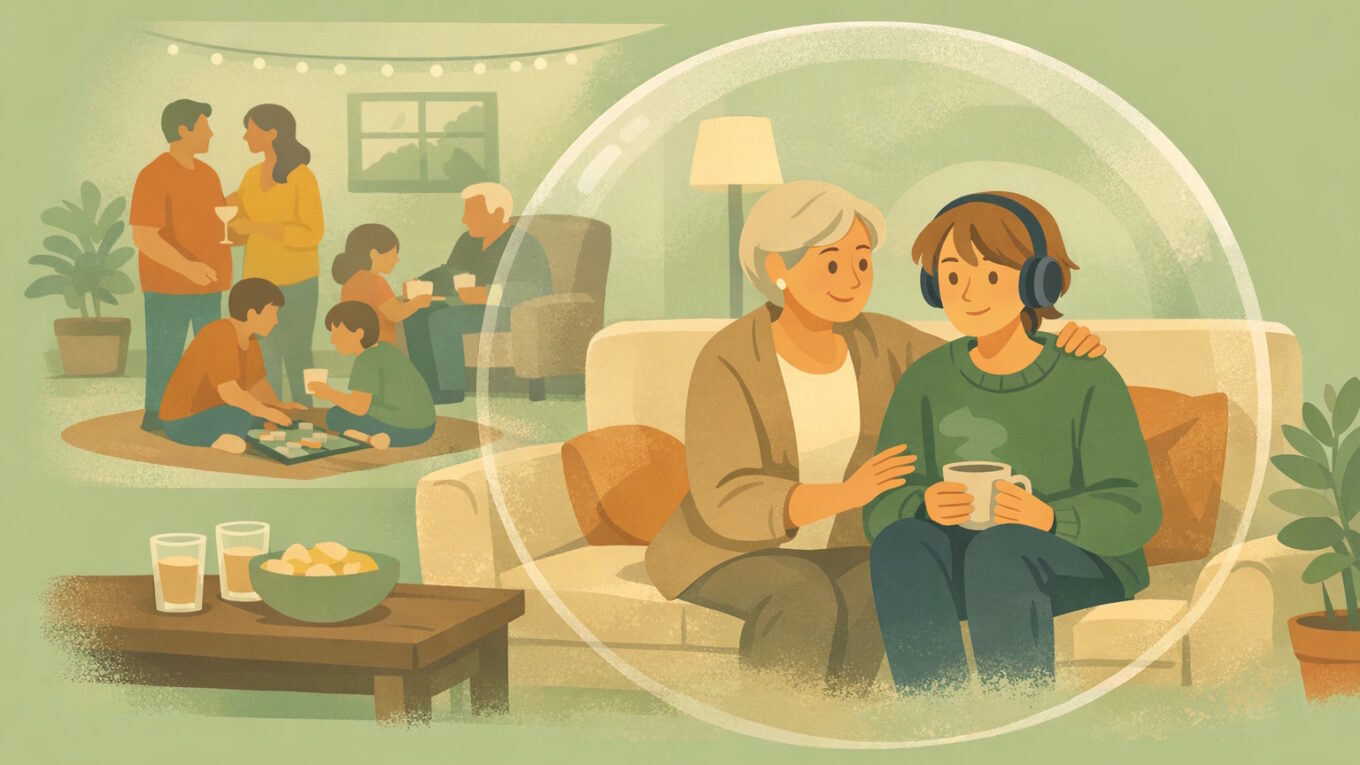
You might have a quiet neurodivergent person in your family – maybe officially diagnosed, maybe not. They’re the one who slips away to another room during gatherings, goes quiet in group chats, or looks exhausted halfway through a holiday.
You care about them. You want them to feel included. You also don’t want to feel like you’re constantly walking on eggshells.
This article is for you if you’re trying to balance all of those things at once. It’s about supporting a neurodivergent family member in everyday family life – gatherings, holidays, group chats – without turning them into a project or a problem.
It will not ask you to become a perfect carer, read a shelf of textbooks, or redesign every tradition from scratch. It will offer some ways to make family life kinder, more flexible, and less overwhelming for everyone. As always, these are based on experience, and may not be suitable for everyone but can be a good place to start.
Summary
- Many quiet neurodivergent people find family gatherings and group chats overwhelming because of sensory input, social pressure and the effort of masking.
- Overload doesn’t always look dramatic. It can show up as withdrawal, going quiet, zoning out, or needing to leave early.
- You don’t need a script for every situation. The most important thing is to believe them when they tell you how something feels, even if it wouldn’t feel that way for you.
- Small practical changes – like having a quiet space, sharing plans clearly, and letting people leave or opt out without guilt – can make a big difference.
- Certain phrases, like “we’re all a bit like that” or “you just need to push yourself”, usually feel invalidating. There are kinder alternatives that offer support without pressure.
- You will get things wrong sometimes. Owning that, listening to feedback, and staying curious is far more important than perfection.
Why family gatherings can feel so heavy
Let’s start with a familiar picture.
It’s a birthday or a holiday. People arrive in waves. The house is full of voices, smells and movement. Someone is cooking. Someone is shouting through from the garden. Kids are running about. The TV is on in the background “for company”.
For some people, that’s energising. For many neurodivergent people, that same scene can be physically painful and mentally exhausting.
Sensory overload
Sensory overload happens when there is more input than a person’s brain can comfortably process. That might include:
- Several conversations happening at once.
- Clattering cutlery, scraping chairs, phones pinging.
- Bright or flickering lights.
- Strong smells from food, perfume, candles or cleaning products.
- Unexpected touch – hugs from relatives, kids hanging off them, someone squeezing past in a crowded room.
If your brain filters this automatically, you might barely notice. For a neurodivergent family member, all of that sound, light and movement may be arriving at full volume, all at once.
You might think, “It’s just a bit lively.” They might be thinking, “If one more thing is added, I’m going to shut down.”
Social overload
Then there’s the social side.
Many neurodivergent people are working very hard under the surface to keep up with:
- Family politics and unspoken rules.
- Jokes and references from years ago.
- Masking – acting “fine” even when they’re struggling.
- Tracking when it’s their turn to talk.
- Answering open questions like “So what are you up to these days?” over and over.
By the time they’ve greeted everyone, found somewhere to sit and survived the first round of small talk, they may already be drained.
None of this means they don’t love you. It means that being present costs them more energy than it costs other people.
How overload can show up in quieter people
When people imagine overload, they often picture a loud meltdown: shouting, crying, storming off. That can happen. But for many quiet neurodivergent people, especially in family settings, overload is much more subtle.
You might see them:
- Going very quiet, even if they can be talkative one-to-one.
- Sitting at the edge of the room, usually in the same chair.
- Scrolling on their phone or fiddling with something just to cope.
- Turning down food or drink because making one more decision feels impossible.
- Answering briefly or sounding blunt when you ask them a question.
- Disappearing to the bathroom, garden or spare room more often than others.
From the outside, that can look “moody”, “rude” or “standoffish”. Inside, they might be thinking:
“I’m already at my limit.”
“I don’t know what to say, but I don’t want to upset anyone.”
“I want to be here, but my brain is shutting down.”
If you assume they’re being difficult, you’ll probably respond with irritation or pressure. If you assume they’re overwhelmed, you’re more likely to respond with care.
Building a gentler container for family life
You don’t have to change everything about your family culture. But you can build a gentler “container” around gatherings, holidays and group chats so that your neurodivergent family member doesn’t have to carry all the weight alone.
One core principle sits underneath everything else:
If they tell you how something feels, believe them – even if it wouldn’t feel that way for you.
You might think:
- “Everyone finds Christmas a bit stressful.”
- “I hate small talk too, but I still join in.”
- “Being around family is tiring for all of us.”
Those things might be true. They also aren’t the point.
The question isn’t “Would this be manageable for me?”
The question is “What can we adjust so it’s more manageable for them?”
When you start from belief rather than doubt:
- You spend less time arguing about whether they’re “overreacting”.
- You spend more time looking for small changes that actually help.
- They feel safer telling you the truth next time.
Do’s and don’ts for gatherings and holidays
You don’t need a grand strategy for every event. A few consistent, practical habits can make family time feel less like a test and more like an invitation.
Before the event
Share the plan clearly.
Even a rough outline can help reduce anxiety:
- Who is likely to be there.
- When things roughly start and finish.
- Any important moments (e.g. “We’ll do presents about 3pm, group photos after dinner”).
- Any surprises they need to know about in advance.
This gives them time to plan spoons and decide how long they can realistically stay.
Ask what would help – and mean it.
You don’t have to have the magic answer. A few gentle questions can open the door:
- “Is there anything that usually makes days like this easier or harder for you?”
- “Would a quieter place to sit be helpful?”
- “If you need to leave early, do you want me to run interference with other relatives so you don’t have to explain it to everyone?”
They might not know what they need yet, or they might be shy to say. That’s okay. The question itself tells them you’re in their corner.
During the event
Make breaks normal, not dramatic.
If you can, set up:
- A quieter room or corner where people can sit without the TV or loud music.
- Softer lighting or fewer competing sounds.
- A clear invitation: “If things get too much at any point, feel free to disappear into here for a bit – it’s completely fine.”
This sends a powerful message: needing a break is expected, not rude.
Protect them from unnecessary pressure.
Sometimes the hardest part isn’t the noise, but other people’s reactions. You can use your social position in the family to make things safer. For example:
- “They’re just taking a breather; they’ll come back down when they’re ready.”
- “They don’t really do big group games, but they’re happy to watch from the side.”
- “Please don’t push them to hug – a wave or hello is absolutely enough.”
You’re not committing to speak for them forever. You’re helping to create a culture where they’re allowed to speak for themselves without backlash.
Offer small, concrete choices.
Open questions like “What do you want to do?” can feel huge and impossible to answer. Smaller choices are usually easier:
- “Do you want to stay in here for a bit, or move to the quieter room?”
- “Would you rather eat now, or wait until it’s a bit calmer?”
- “I’m going for a short walk – you’re welcome to come, or stay put if that’s better for you.”
If they say no, try to let it be a simple no, not the start of a negotiation.
After the event
You don’t need a heavy debrief. A simple follow-up can still mean a lot:
- “It was really nice to see you today. Thanks for coming.”
- “If anything was hard that we can tweak next time, I’m happy to hear it – no rush.”
No interrogation, no demand for immediate feedback. Just an open door.
Group chats, messages and online spaces
Not all overwhelm happens in person. Family group chats can be intense in their own way.
Some things you can do there:
- Don’t pressure instant replies. If they leave a message on read, assume life is happening, not that they’re ignoring you.
- Avoid calling them out for being quiet. Messages like “You never say anything in here” usually make people withdraw further, not join in more.
- Keep key information clear. If you’re organising something, put the important details in one message instead of spreading them across lots of jokes and side conversations.
- Model healthy boundaries. You can say things like, “I’m going to mute this for a bit, but I love you all” to normalise stepping back.
If you’re not sure whether something works for them, you can always ask privately:
“Hey, just checking – are the family chats okay for you, or do we need to do anything differently?”
“Please don’t say…” (and kinder alternatives)
You might recognise yourself in some of these phrases. Most of us have said something like this at some point. This isn’t about shaming you. It’s about understanding how these comments can land – and what you could say instead.
“We’re all a bit like that.”
Why it stings:
- It turns a specific support need into a vague personality quirk.
- It suggests they’re making a fuss over something everyone deals with.
- It shifts the focus back to how you relate, instead of how they are struggling.
You could try instead:
- “I can’t fully imagine what that’s like, but I believe you.”
- “Thank you for explaining. What might make this easier for you today?”
“You just need to push yourself.”
Why it stings:
- It assumes lack of effort instead of lack of capacity or support.
- It ignores the pushing they’re probably already doing just to show up.
- It can push them straight into meltdown, shutdown or burnout.
You could try instead:
- “It’s okay to stop before you hit your limit.”
- “If you want to try something a bit outside your comfort zone, I’m here to support you – and it’s also okay if today isn’t the day.”
“But you seem fine.”
Why it stings:
- It suggests their internal experience doesn’t count unless it matches what you see.
- It encourages them to mask harder, which is exhausting and usually unsustainable.
- It implies they need to be visibly falling apart before you’ll take them seriously.
You could try instead:
- “I wouldn’t have known you were struggling – thank you for telling me.”
- “You don’t have to look a certain way for this to be real.”
“You used to love this as a kid.”
Why it stings:
- It ignores the fact that needs, capacity and tolerance can change over time.
- It can feel like you’re holding a past version of them against their present reality.
- It frames their current needs as a disappointment.
You could try instead:
- “It sounds like this doesn’t work for you anymore – that’s okay.”
- “Let’s see if there’s a version of this that fits who you are now.”
“You’re making everyone uncomfortable.”
Why it stings:
- It turns their struggle into a moral failing.
- It teaches them that other people’s comfort matters more than their wellbeing.
- It makes it less likely they’ll be honest with you next time.
You could try instead:
- “I can see you’re not okay – let’s figure this out together.”
- “If you need to step away, that’s completely fine. We can catch up later.”
If you are the neurodivergent person sharing this
You might be reading this as the quiet person in your family, wondering whether to send it to someone.
You are allowed to:
- Share this instead of explaining everything from scratch every time.
- Decide you don’t currently have the energy to explain at all.
- Have needs that don’t match every example in this article.
If someone in your family is reading this because you sent it, I hope it gives you both a starting point. You don’t have to fix every misunderstanding in one conversation. You can take it one small change at a time.
Living with some uncertainty in families
Being kind to a quiet neurodivergent person in your family is not about turning them into the life and soul of the party.
It’s about:
- Accepting that their brain works differently.
- Adjusting the environment where you realistically can.
- Respecting their boundaries, even when you don’t fully understand them.
- Staying in relationship gently, over time, without constant pressure.
You will misunderstand each other sometimes. You will say the wrong thing. So will they. That’s part of being human, and part of being family.
What matters most is not never getting it wrong, but what you do next: whether you listen, apologise when you need to, and keep trying.
If you can believe them, take their needs seriously, and stay interested in their reality, you are already doing something many neurodivergent people never get from their families:
You’re showing them that who they are is welcome – not a problem to be fixed, but a person to be cared for as they are.

I’m Andrew, the person behind Quietly Neurodivergent. I’m an autistic adult who spent many years trying to pass as “fine” – holding things together at work, showing up to meetings, hitting deadlines – and then unravelling in private. I know what it feels like to look competent on the outside while running on fumes underneath.
By day I work with student data in higher education; by night (and very early mornings) I’m a part-time PhD student thinking about education, inequality and how people move through systems that were never quite built for them. I’ve also spent nearly ten years as a town councillor and I volunteer as a Beaver Scout Leader, which means I’ve had a lot of practice navigating meetings, forms, responsibilities and sensory/social overload at the same time. That mix of lived experience, community work and research shapes how I write here: practical, plain-English pieces that sit somewhere between “this is what it’s like” and “here are some things you could try”.
I’m not a clinician and I don’t offer diagnosis, therapy or miracle fixes. What I can offer are honest accounts of what has and hasn’t helped me with study, work and everyday life, alongside small, realistic tools you can adapt for yourself. If you recognise yourself in the phrase “quietly neurodivergent”, this site is for you.
Discover more from Quietly Neurodivergent
Subscribe to get the latest posts sent to your email.