Social Invitations, Guilt and Saying No Without Burning Bridges
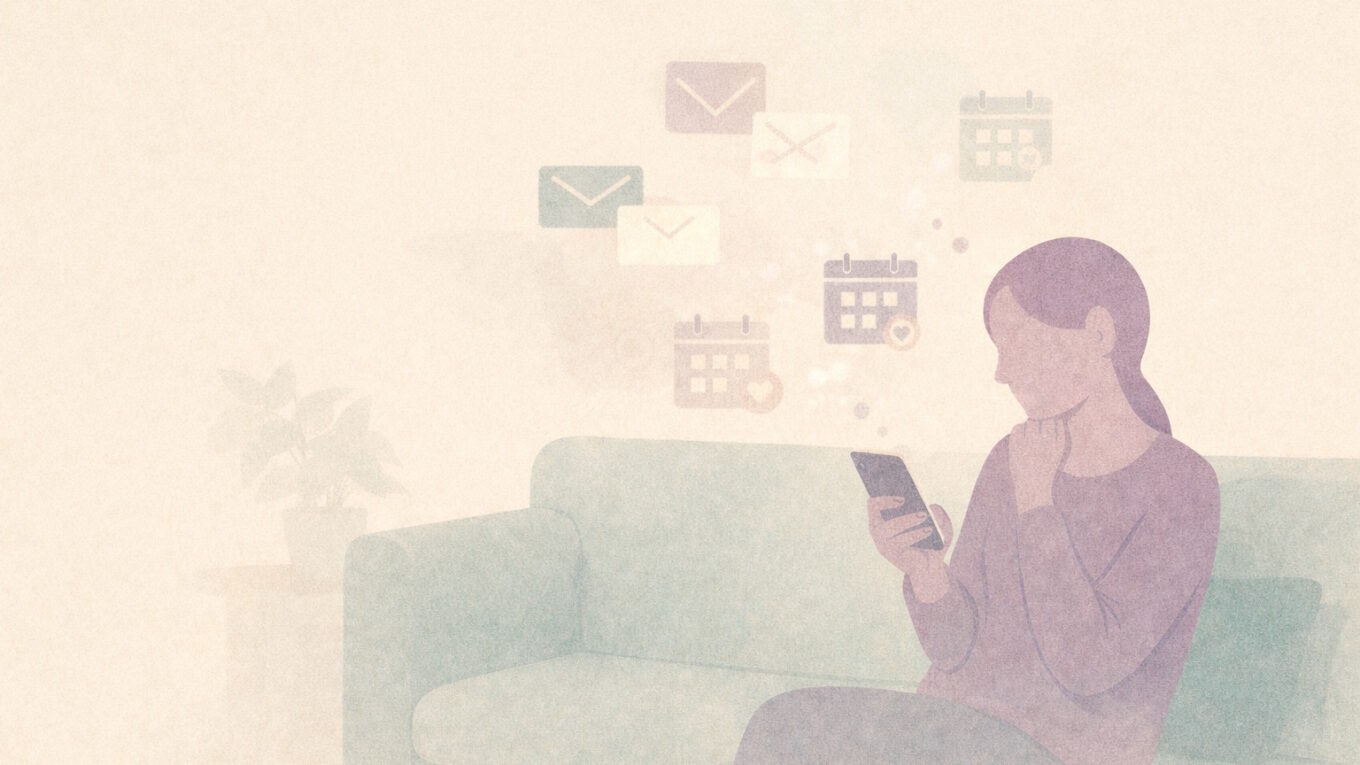
There are times of year when social invitations multiply. Work dos, school events, family gatherings, neighbours’ drinks, “just a quick catch-up”. On paper it can look like a string of nice things. From the inside, if you’re autistic, ADHD or otherwise neurodivergent, it can feel like someone has booked out your energy without asking.
You might say yes because it seems expected, then spend days dreading it. You might cancel at the last minute and feel awful. You might go, mask your way through, and then crash hard afterwards.
This article is about that pattern: invitations, pressure, guilt, and how to say “no” (or “yes, but differently”) in ways that protect your energy and your relationships.
I’ll speak from my own experience as a quietly neurodivergent adult with work, family, study and volunteering in the mix, but please treat this as a menu of ideas, not a set of rules.
Quick Summary
- Social invitations often carry hidden costs for neurodivergent people: sensory overload, masking, travel, recovery time and disrupted routines.
- Saying yes to everything can quietly push you towards burnout; saying no can trigger guilt and fear of upsetting people.
- Getting honest about your actual capacity – how many “social slots” you have, and what kinds of events drain or nourish you – makes decisions easier.
- You can say no kindly with simple, repeatable phrases, and you can adjust some invitations (“I’ll drop in for an hour”) instead of attending on default terms.
- Protecting your energy doesn’t mean you don’t care about people. It means you’re trying to show up in ways that are sustainable, rather than disappearing completely when you run out of spoons.
Why social invitations are heavier than they look
A single event is rarely just “turn up and chat” for a neurodivergent person. It can include:
- noise, crowds, overlapping conversations
- bright lights, unfamiliar spaces, unexpected sensory surprises
- pressure to make eye contact, smile, and perform small talk
- worry about saying the wrong thing or not knowing when to leave
- travel there and back
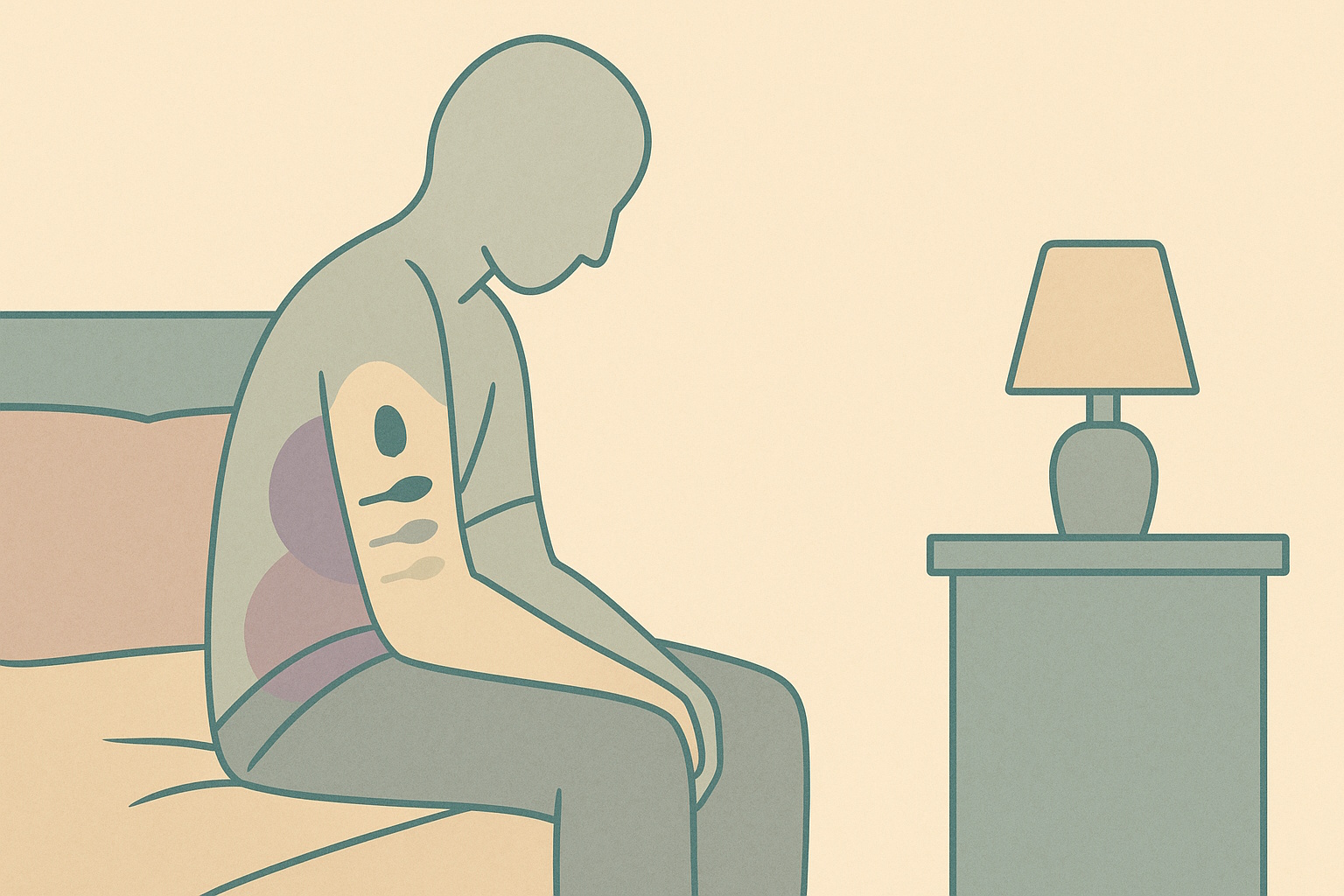
- the recovery time afterwards, when you’re exhausted and flat
On top of that, there’s often a mental script running in the background:
- “Will I seem rude if I don’t go?”
- “What if I get stuck and can’t leave?”
- “What if I have a shutdown or meltdown?”
- “What will people think if I say no again?”
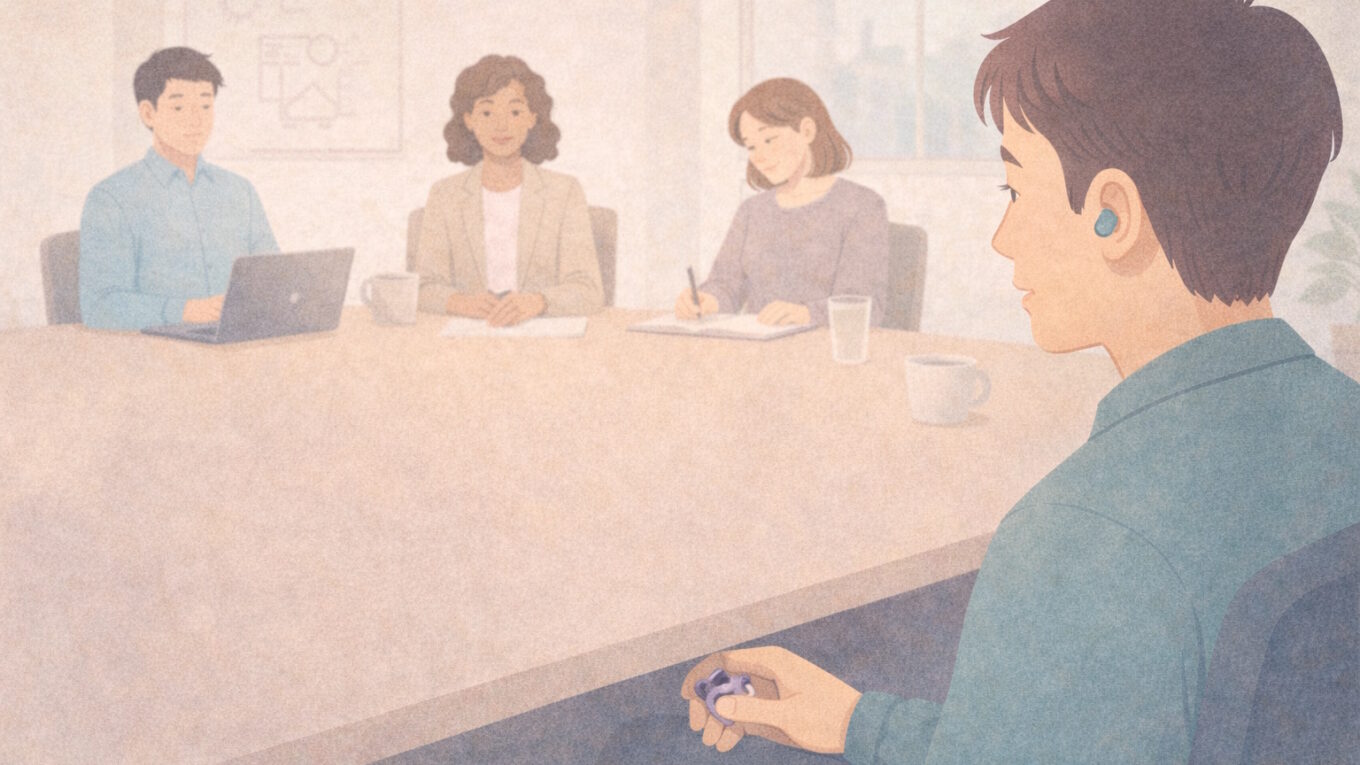
For me, the cost shows up most clearly afterwards. I can get through an event by masking and being “on”, especially around people who don’t know I’m neurodivergent. But once I’m home again, my brain and body feel like they’ve run a marathon. That crash makes the next day harder for my family, my work and me.
None of that shows on the invitation.
The guilt spiral: saying yes, dreading it, crashing later
Many of us recognise a pattern like this:
- An invitation arrives.
- You feel pressure to say yes quickly, before you “let anyone down”.
- As the date gets closer, your anxiety or dread spikes.
- You either:
- force yourself to go and then crash afterwards, or
- cancel, feel enormous guilt, and worry about the relationship.
From the outside, it can look like you’re flaky or antisocial. From the inside, you may care deeply about the people involved and still not have the spoons to manage the event in the way it’s offered.
The goal isn’t to eliminate guilt entirely (most humans feel some guilt around boundaries). The goal is to have enough clarity that you can say yes or no on purpose, not just from panic.
Getting honest about your social capacity
It can help to think of your social energy as something with a rough limit, just like sleep or physical stamina.
A few questions you might gently ask yourself:
- How many social events can I handle in a typical week without crashing?
- Which kinds of events are most draining (large groups, noisy venues, unstructured gatherings, work-adjacent things)?
- Which kinds are easier or even nourishing (one-to-one, short visits, familiar people, predictable routines)?
- What else is happening around the same time (deadlines, family stress, study, holidays)?
You don’t need perfect answers. Even noticing “I really can’t do two big things in the same weekend” is useful data.
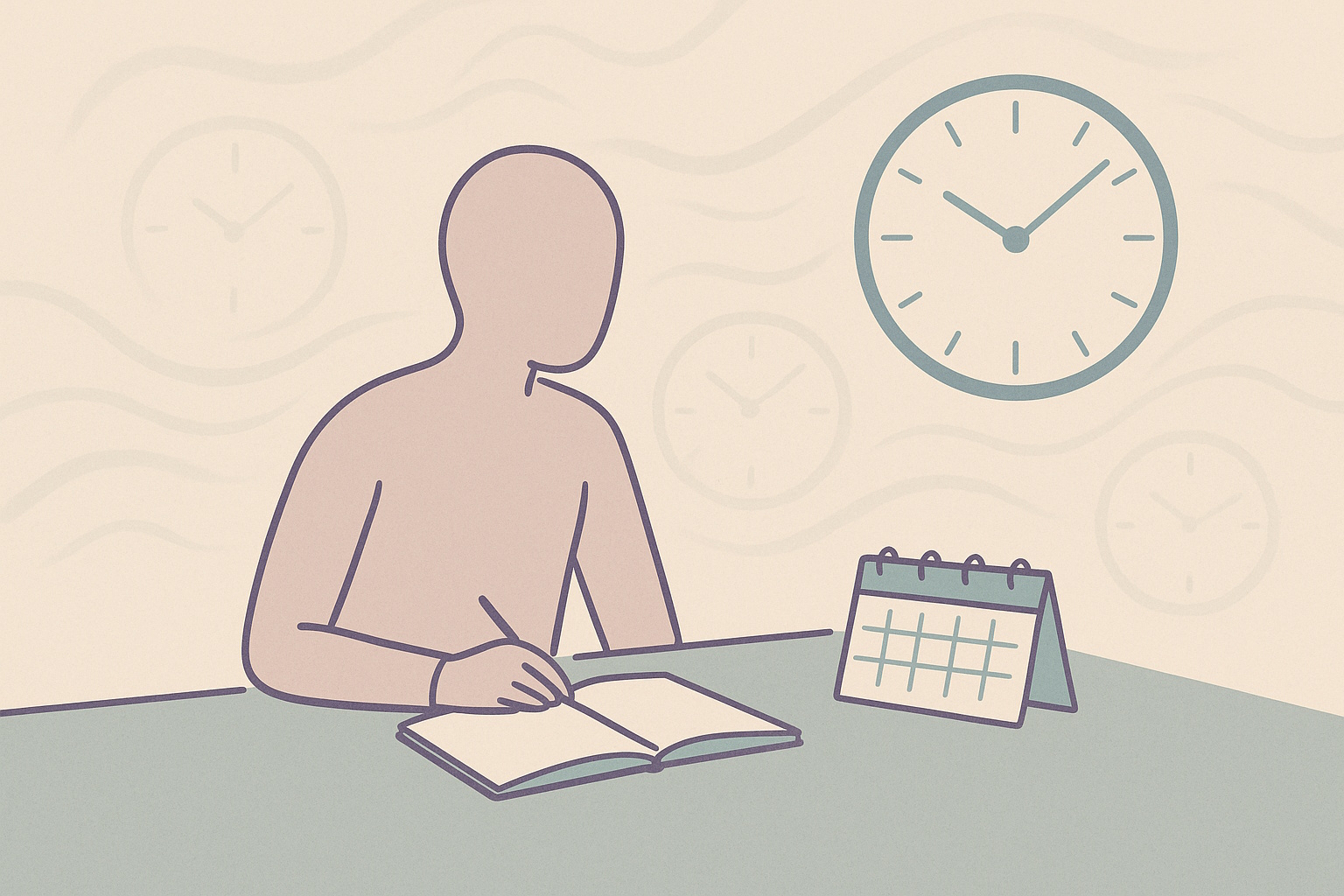
Around busy seasons like Christmas and New Year, it may help to decide:
- a rough maximum number of social things you can do, and
- what kind of events get those “slots” (for example: one family thing, one close-friends thing, one children-related event).
You can keep this to yourself. It’s simply a private guide so that when invitations arrive, you’re not starting from zero each time.
Three kinds of invitations
One way to reduce decision fatigue is to roughly sort invitations into three groups.
1. “Non-negotiable” (or close to it)
These might be:
- key family commitments you genuinely want to honour
- events where your presence matters for your children
- a work thing where absence would have clear consequences
Even here, you may still be able to adjust how you attend (shorter time, quieter corner, leaving early).
2. “Meaningful but optional”
These are invitations you’d like to say yes to if you have capacity:
- seeing a friend you feel safe with
- a small gathering where you can be yourself
- a celebration that genuinely matters to you
Here you can be more honest with yourself: do you have a “yes” that you will not resent later?
3. “Polite only”
These are the ones that mainly exist to avoid awkwardness:
- distant colleagues’ nights out
- people you barely know
- events that combine every difficult element for you (noise, crowds, late finishes)
It is okay for most of these to be “no” by default, especially in a busy season.
This sorting is not about ranking people’s value. It’s about matching invitations to your actual capacity.
Ways of saying no that keep the door open
You don’t owe anyone your full medical history to decline an invitation. You are allowed to use simple, ordinary language.
Here are some options you can adapt.
Simple, honest-ish no (without details)
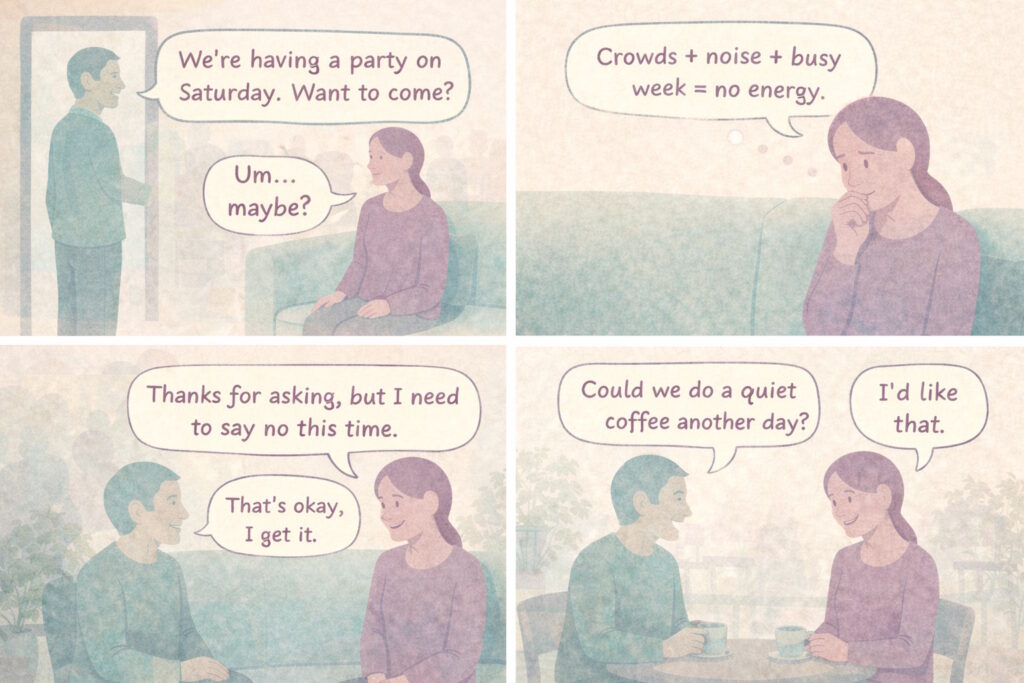
- “Thank you for asking, but I’m going to pass this time.”
- “I really appreciate the invite, but I need to say no on this occasion.”
- “We’ve got a lot on at the moment, so I’m taking on fewer things. I’ll have to miss this one.”
No with a gentle hint about energy
- “I’m a bit low on energy/social battery at the moment, so I’m keeping things very quiet. I’ll skip this one but hope it goes well.”
- “I’ve learned the hard way that too many events in a short time push me towards burnout, so I have to say no here.”
No with a future-facing note
Only use this if you genuinely mean it.
- “I can’t do this, but I’d really like to catch up one-to-one in the new year.”
- “I’m not up to a big event, but a short walk/coffee sometime would be lovely.”
You can keep the wording very neutral. Most people don’t need a detailed explanation; they just need to know you’re not rejecting them as a person.
Saying “yes, but differently”
Sometimes you want to see the person, but not in the exact way they’ve suggested. You’re allowed to negotiate the format.
Examples:
- “I can’t stay for the whole evening, but I can drop in for an hour.”
- “Big group events are hard for me; would it work if we met for a coffee earlier in the day instead?”
- “I’d love to see you, but that venue is a bit much for me. Could we meet somewhere quieter another time?”
For family gatherings:
- “We’ll come for lunch, but we’ll need to head off mid-afternoon so the kids (and I) don’t get overtired.”
- “That whole day would be too much for us, but we can manage the morning.”
You’re not being awkward; you’re trying to find a version of the invitation that doesn’t cost you the entire week.
When you’ve already said yes and need to back out
Sometimes you realise too late that you over-promised. It happens.
If you can see the crash coming, backing out early is usually kinder than pushing yourself to the point of meltdown or shutdown.
Possible wordings:
- “I’m really sorry, I said yes too quickly and I’ve realised I don’t have the energy or health capacity to do this. I know that’s disappointing, and I appreciate your understanding.”
- “This week has turned out heavier than I expected and I’m running on fumes. I need to look after my health and step back from this event, but I do value you and hope we can arrange something smaller another time.”
People who care about you may be disappointed, but they are much more likely to understand this than a vague, last-minute disappearance.
Using your support systems
If you live with family or close friends who understand your neurodivergence, you can enlist them.
For example:
- agreeing together which events are realistic for your household
- having a partner or friend as the “driver” so you have an easy exit
- using a quiet code phrase for “I need to leave”
- letting someone else handle small talk when your brain has dropped to low battery
If you’re a parent, it can help to frame it for your children in simple terms:
- “Big busy places use up my energy quite quickly, just like some things use up yours. That’s why I sometimes say no to extra things – it helps me still have energy for you.”
You don’t have to make it a big dramatic disclosure. Small, honest sentences are enough.
A quiet closing thought
Around Christmas, New Year and other social seasons, it can feel as if the world is sending you a steady stream of “shoulds”:
- you should go
- you should be sociable
- you should be grateful for every invite
If your brain and body don’t work like that, it’s easy to slide into shame and over-commitment.
You are allowed to notice that invitations have a cost as well as a benefit. You are allowed to say no kindly. You are allowed to prefer small, quiet, predictable things over big loud ones. You are allowed to protect your energy so that the people who live with you don’t only see the tired, crashed-out version of you.
You will probably still feel guilty sometimes. Most of us do. But guilt doesn’t automatically mean you’re doing the wrong thing.
If one sentence from this article gives you a way to decline an invitation, shorten a visit, or arrange a calmer catch-up without burning a bridge, that’s enough.
You’re not antisocial. You’re managing a limited resource in a world that often pretends everyone has unlimited spoons. That’s not selfish; it’s survival.

I’m Andrew, the person behind Quietly Neurodivergent. I’m an autistic adult who spent many years trying to pass as “fine” – holding things together at work, showing up to meetings, hitting deadlines – and then unravelling in private. I know what it feels like to look competent on the outside while running on fumes underneath.
By day I work with student data in higher education; by night (and very early mornings) I’m a part-time PhD student thinking about education, inequality and how people move through systems that were never quite built for them. I’ve also spent nearly ten years as a town councillor and I volunteer as a Beaver Scout Leader, which means I’ve had a lot of practice navigating meetings, forms, responsibilities and sensory/social overload at the same time. That mix of lived experience, community work and research shapes how I write here: practical, plain-English pieces that sit somewhere between “this is what it’s like” and “here are some things you could try”.
I’m not a clinician and I don’t offer diagnosis, therapy or miracle fixes. What I can offer are honest accounts of what has and hasn’t helped me with study, work and everyday life, alongside small, realistic tools you can adapt for yourself. If you recognise yourself in the phrase “quietly neurodivergent”, this site is for you.