“Am I Just Making This Up?” Navigating Doubt After a Late Neurodivergent Diagnosis
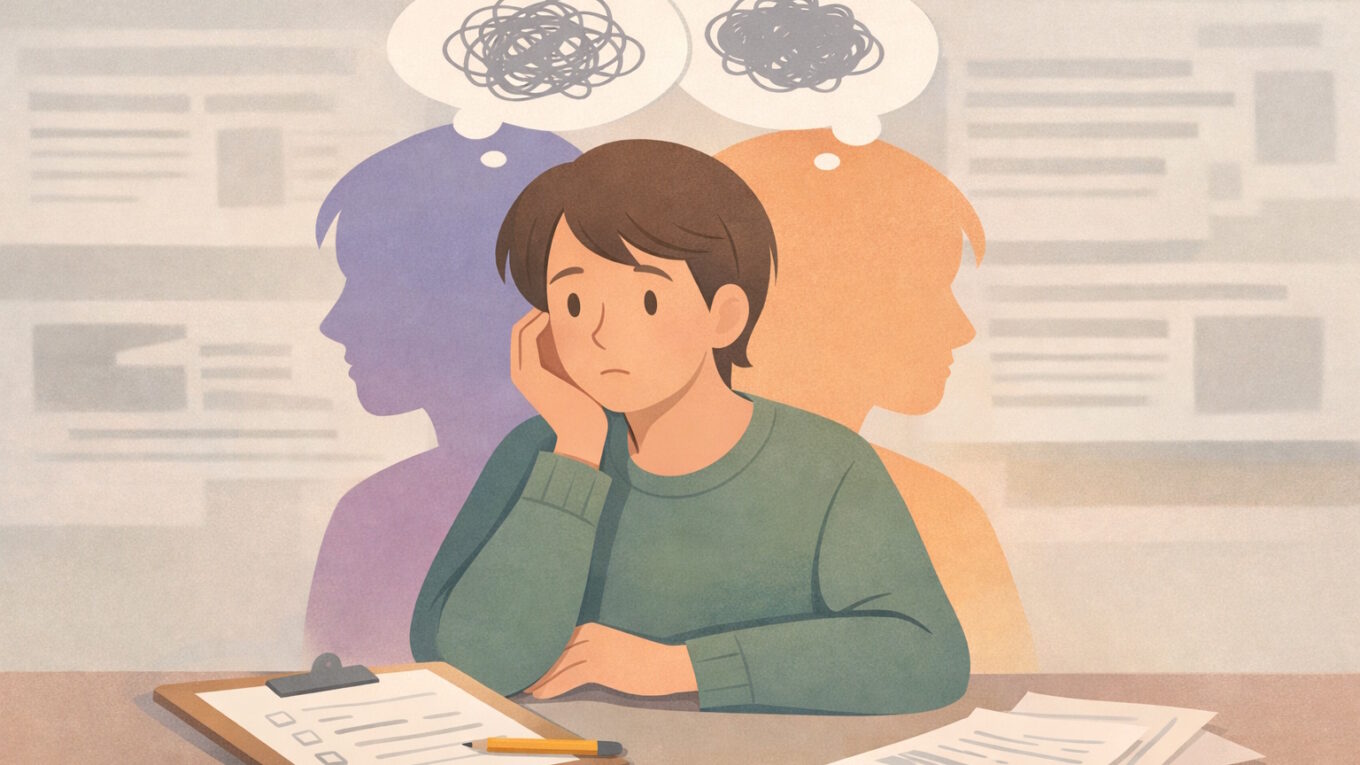
Late diagnosis or self‑identifying as autistic or ADHD can be a relief and a shock at the same time. You finally have language for why life has felt the way it has – and then another part of your brain quietly asks, “What if I’m making this up?”
This article is for you if that question won’t leave you alone. It won’t try to prove that you are or aren’t autistic or ADHD. Instead, it looks at where doubt often comes from, how wider conversations about “overdiagnosis” get under your skin, and some practical ways to come back to your own experience.
Remember, Quietly Neurodivergent does not provide diagnosis, medical advice or crisis support. This piece is for information and reflection only.
Summary
- Doubting your diagnosis or self‑identification is common, especially if you came to it later in life.
- Years of masking and being told you are “too sensitive” or “making a fuss” can make it hard to trust your own perception.
- Media and political stories about “everyone being diagnosed these days” often turn into self‑criticism.
- Family and friends may say things that feel minimising, even when they mean to be kind.
- Wanting language, understanding and realistic support is a valid reason to explore neurodivergence.
- Looking at long‑term patterns and checking in with people you trust can help when doubt is loud.
What that “am I faking it?” feeling can look like
For many people, doubt shows up in small, repetitive thoughts more than in one big moment. You might notice things like:
- Replaying the assessment and wondering if you answered “too strongly”.
- Thinking about friends who seem to struggle more and deciding they are “properly” autistic or ADHD in a way you are not.
- Downplaying past difficulties: “Was it really that bad? Maybe I was just dramatic.”
- Feeling embarrassed when you say “I’m autistic” or “I have ADHD” out loud, as if someone is about to correct you.
It can be confusing when you recognise yourself strongly in autistic or ADHD traits one day, and the next day think, “Maybe I’ve just been reading too much about this.” Nothing in your life has changed overnight, but your sense of what “counts” as real seems to wobble.
You are not the only one who feels this way. Doubt after a late diagnosis is very common. That doesn’t make it pleasant, but it does mean there are reasons for it that go beyond “I must be lying to myself”.
How doubt gets built over time
Most people don’t wake up at 30 or 45 with a sudden belief that their own perception is untrustworthy. That belief usually has a long history.
You might recognise some of these experiences:
- As a child, you said the classroom was too loud and were told to “just concentrate”.
- Certain clothes, foods or smells made you feel sick, and adults laughed or told you not to be fussy.
- You were exhausted after school or work and were told you were lazy, dramatic or not trying hard enough.
When this happens over and over again, you learn that there is a gap between how life feels to you and how other people say it is. To stay out of trouble, you may start to treat other people’s descriptions as more reliable than your own.
On top of that, many autistic and ADHD people mask – copying what seems to be acceptable behaviour in order to blend in. You might have become very good at sounding fine, making eye contact, or pushing through sensory discomfort, even when it costs you a lot. From the outside, it can look as though you are coping well. From the inside, you may be counting down to when you can finally be alone.
When a diagnosis or self‑identification arrives, it cuts across that whole set of habits. It says: your brain has been trying to tell you something for years, and it was not imagining it. No wonder another part of you reaches for the old script: “Are you sure? What if you’re overreacting? What if someone else knows you better than you know yourself?”
That script is familiar. Familiar doesn’t mean true.
Media noise about “overdiagnosis” and trends
All of this happens against a noisy background. You don’t doubt yourself in a quiet, neutral space.
Headlines and posts about autism and ADHD appear regularly. Some of them raise sensible questions about access to support. Others lean heavily on phrases like:
- “Everyone’s Autistic/ADHD now.” That one really grinds my gears.
- “Autism has become fashionable.”
- “Are we overdiagnosing neurodivergence?” This one annoys me so much that I wrote an article solely about it.
You might think you are ignoring these until you are lying awake asking yourself whether you only relate to ADHD because you’ve spent time on certain corners of the internet. Or you hear a commentator joking that autism is being “handed out like sweets”, and a part of you quietly thinks, “My life hasn’t been as hard as some people’s. Maybe I don’t count.”
Most of these pieces are talking about systems – waiting lists, criteria, budgets. But because diagnosis is so personal, it is easy for “too many people are being diagnosed” to land as “people like you are suspect”.
If you have already learned to doubt your perception, those stories have something to stick to. They do not create your self‑doubt from scratch, but they can amplify it.
Policy debates that feel very personal very quickly
Similar things happen with discussion about benefits and adjustments. News articles, social media threads or workplace conversations may focus on people “gaming the system” or getting “special treatment”.
If you are already uneasy, it is a short jump from those stories to thoughts like:
- “What if I took a diagnosis slot from someone who needed it more?”
- “What if my access request at work is actually unreasonable?”
It is understandable to care about fairness. It is also worth remembering that you were living your life – and running into the same walls – long before you heard any of these arguments. Whatever label you use, you have been the one dealing with your brain and body every day.
Wanting clearer language for your experience, and support that matches how you actually work, is not the same as manipulating a system.
Family, friends and the “Are you sure?” conversations
Reactions from people close to you often land hardest. Not every family member or friend will respond badly. Some may say, “That makes sense,” and quietly adjust how they relate to you. Others may be confused, defensive or simply unfamiliar with what autism and ADHD can look like in adults.
You might hear things like:
- “But you’re so chatty; you can’t be autistic.”
- “We all lose our keys sometimes – everyone’s a bit ADHD.” Grrr.
- “You did well at school, so how bad can it be?”
- “People in my day just got on with it.”
Often, the person thinks they are being reassuring. They may be trying to say, “You’re normal to me.” What you hear is more like, “I don’t believe you,” or, “Your difficulties don’t count.”
If you already have a wary relationship with your own perception, it can be jarring to hear your private doubts coming out of someone else’s mouth. It can feel like confirmation that you are making a fuss or misreading yourself.
You can’t control other people’s first reactions. You can choose how much of your energy you spend trying to persuade them. It is reasonable to:
- Change the subject when a conversation turns into a debate about labels.
- Say, “This fits my experience, even if it doesn’t match your picture of autism or ADHD.”
- Share more detail with people who listen carefully, and less with people who consistently minimise.
Your diagnosis or self‑understanding does not depend on getting unanimous approval from everyone you know.
“Maybe I just wanted an excuse”
Another common strand of doubt sounds like this: “What if I only wanted a diagnosis so I could get away with things? What if I’m just lazy and looking for a label to hide behind?”
There are a few layers here. One is the idea that needing support is suspicious. Another is the belief that your past coping proves you didn’t really need help.
Many late‑identified autistic and ADHD people have already spent years running life on what is effectively hard mode. You might see yourself in some of these patterns:
- Staying late most days to redo tasks you struggled to start or organise earlier.
- Using evenings and weekends to recover from the sensory and social load of your job or studies.
- Building complex workarounds – detailed scripts, colour‑coded calendars, carefully controlled routines – just to keep things going.
From the outside, this can look like competence. From the inside, it may have felt like constantly running one step ahead of collapse.
When you finally have a name for what you have been doing, it is easy to think, “If I managed before, maybe it wasn’t that serious. Maybe I’d be cheating if I ask for adjustments now.” But surviving without the right tools doesn’t mean you never needed them. It just means you carried the extra load yourself.
Wanting language and understanding is also a good enough reason to explore diagnosis or self‑identification, even if you never apply for a single benefit. Knowing that your difficulty starting tasks has a name, or that your need for quiet is part of how your brain works, can change how you plan your time and how you talk to people close to you.
Benefits and formal adjustments are a separate, practical question. You might apply, you might not, and systems may respond in ways that feel fair or unfair. None of that retroactively decides whether your experience was real.
Ways to ground yourself when doubt spikes
When your brain starts running through every worst‑case scenario – “What if I’m faking, what if people are laughing at me, what if I’ve imagined all of this?” – it can help to have something more solid to come back to.
Here are a few ideas you could experiment with.
Look for patterns over time
Diagnosis, whether formal or self‑directed, is usually based on patterns, not isolated moments. One successful presentation or one well‑masked social event does not erase years of difficulty.
You could look for patterns in:
- Old reports and feedback. School reports, performance reviews or emails may contain repeated comments such as “bright but disorganised”, “careless mistakes”, “struggles with change” or “quiet in groups”. To me, these were hugely familiar and strangely comforting at the same time.
- Energy and recovery. Notice which situations leave you unusually drained or overloaded compared with people around you – open‑plan offices, back‑to‑back meetings, unstructured days, group work.
- Burnout cycles. You might see a familiar arc of coping for a while, then crashing: struggling with basic tasks, needing to withdraw socially, feeling physically and emotionally emptied out. After certain events, I know to “book” the following day out as I will be done.
You don’t need perfect records or detailed charts. Even a rough sense of “this has been a theme for a long time” can help counter the idea that you suddenly invented these traits after seeing a few videos.
Ask yourself different questions
When doubt is loud, the questions it asks tend to be hostile: “Who do you think you are? What if you’re wrong?” It can be useful to have a few alternative questions ready – ones that are curious rather than accusatory.
For example:
- What was happening in my life when I first started wondering about autism or ADHD?
- What patterns or struggles led me to seek assessment or start reading more?
- Since I began seeing myself as autistic or ADHD, what has become easier to explain? What decisions have made more sense?
- If I treated my brain as trustworthy for one day, what would I change about how I work, rest or ask for help?
You don’t have to force yourself to feel convinced. The aim is simply to give yourself another way of looking at the same information.
Check in with people who take you seriously
Not everyone’s opinion carries the same weight when you are questioning yourself.
It may help to identify a small number of people – offline or online – who:
- Take your experience seriously, even if they don’t share it.
- Have seen you over a reasonable stretch of time.
- Can tell you what they notice about your patterns without making you feel judged.
You can then choose to check in with those people when doubt is loud, rather than with whoever happens to be nearest or most opinionated.
If you spend time in online neurodivergent spaces, you can also be selective. Some accounts and communities will make you feel seen and calmer. Others may leave you more anxious or competitive about who is “neurodivergent enough”. It is fine to mute or step back from spaces that don’t feel helpful.
Living with some uncertainty
It would be nice if a late diagnosis came with a permanent feeling of certainty: no more questions, no more wobble. In practice, self‑understanding is often a moving process.
Over time, you may find that:
- You relate more to autism than to ADHD, or the other way round.
- You recognise yourself in both and use the word AuDHD, even if your paperwork is less tidy.
- You also find language from other areas – trauma, chronic illness, sensory processing – that describes parts of your experience.
None of that means you have been pretending. It means you are refining your picture of yourself as you learn more.
One way to think about diagnosis or self‑identification is as a working model: the best current description you have of how your brain and body move through the world. The useful question is less “Is this label perfect?” and more “Does this understanding help me make better, kinder decisions for myself right now?”
You don’t have to reach 100% certainty before you start acting on what you know. You can plan your days in a way that respects your energy, ask for reasonable adjustments, and choose environments that fit you better, even if part of you still has questions.
The doubt may not disappear entirely. It also doesn’t get to erase the years of experience you carry. If you recognise yourself in autistic or ADHD traits, and if thinking in those terms helps you live more sustainably, that is already meaningful information.
You are not making that up.

I’m Andrew, the person behind Quietly Neurodivergent. I’m an autistic adult who spent many years trying to pass as “fine” – holding things together at work, showing up to meetings, hitting deadlines – and then unravelling in private. I know what it feels like to look competent on the outside while running on fumes underneath.
By day I work with student data in higher education; by night (and very early mornings) I’m a part-time PhD student thinking about education, inequality and how people move through systems that were never quite built for them. I’ve also spent nearly ten years as a town councillor and I volunteer as a Beaver Scout Leader, which means I’ve had a lot of practice navigating meetings, forms, responsibilities and sensory/social overload at the same time. That mix of lived experience, community work and research shapes how I write here: practical, plain-English pieces that sit somewhere between “this is what it’s like” and “here are some things you could try”.
I’m not a clinician and I don’t offer diagnosis, therapy or miracle fixes. What I can offer are honest accounts of what has and hasn’t helped me with study, work and everyday life, alongside small, realistic tools you can adapt for yourself. If you recognise yourself in the phrase “quietly neurodivergent”, this site is for you.
Discover more from Quietly Neurodivergent
Subscribe to get the latest posts sent to your email.